
Coffey, Hopkinsville Kentuckian, October 29, 1901
Dublin Core
Title
Subject
Description
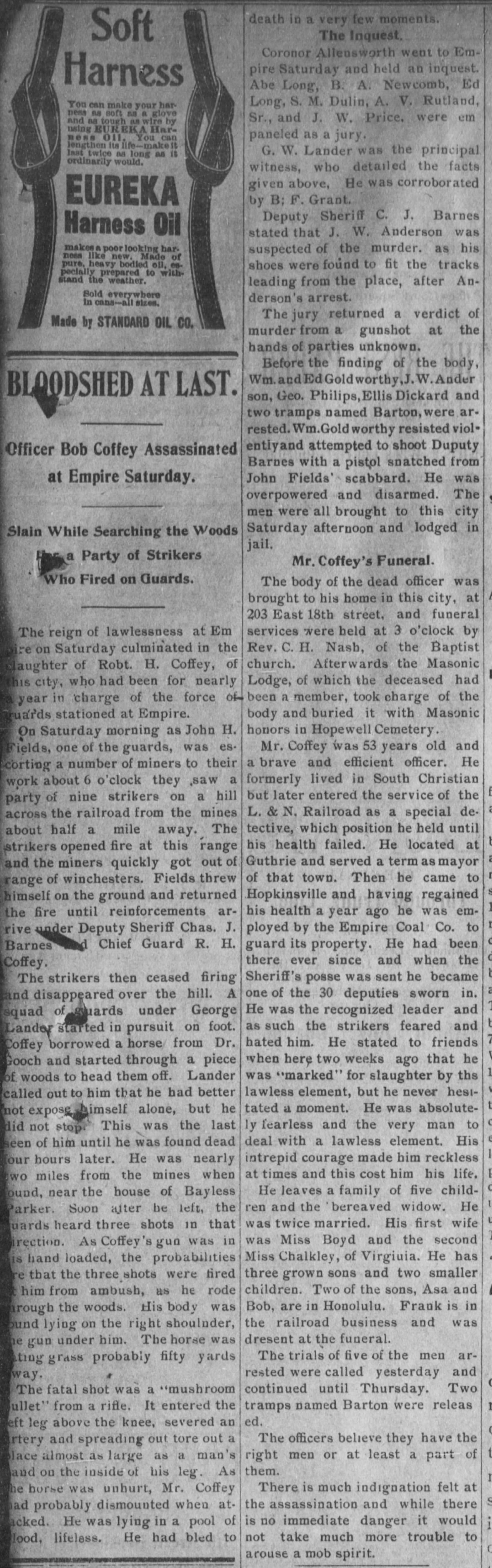
BLOODSHED AT LAST.
Officer Bob Coffey Assassinated at Empire Saturday.
Slain While Searching the Woods for a Party of Strikers who Fired on Guards.
The reign of lawlessness at Empire on Saturday culminated in the slaughter of Robt. H. Coffey, of this city, who had been for nearly a year in charge of the force of guards stationed at Empire.
On Saturday morning as John H. Fields, one of the guards, was escorting a number of miners to their work about 6 o’clock they saw a party of nine strikers on a hill across the railroad from the mines about half a mile away. The strikers opened fire and the miners quickly got out of range of winchesters. Fields threw himself on the ground and returned the fire until reinforcements arrive [sic] under Deputy Sheriff Chas. J. Barnes and Chief Guard R. H. Coffey.
The strikers then ceased firing and disappeared over the hill. A squad of guards under George Lander started in pursuit on foot. Coffey borrowed a horse from Dr. Gooch and started through a piece of woods to head them off. Lander called out to him that he had better not expose himself alone, but he did not stop. This was the last seen of him until he was found dead four hours later. He was nearly two miles from the mines when found, near the house of Bayless Parker. Soon after he left, the guards heard three shots in that direction. As Coffey’s gun was in his hand loaded, the probabilities are that the three shots were fired at him from ambush, as he rode through the woods. His body was found lying on the right shoulder, the gun under him. The horse was eating grass probably fifty yards away.
The fatal shot was a “mushroom bullet” from a rifle. It entered the left leg above the knee, severed an artery and spreading out tore out a place almost as large as a man’s hand on the inside of his leg. As the horse was unhurt, Mr. Coffey had probably dismounted when attacked. He was lying in a pool of blood, lifeless. He had bled to death in a very few moments.
The Inquest.
Coroner Allensworth went to Empire Saturday and held an inquest. Abe Long, B. A. Newcomb, Ed Long, S. M. Dulin, A. V. Rutland, Sr., and J. W. Price, were empaneled as a jury.
G. W. Lander was the principal witness, who detailed the facts given above. He was corroborated by B. F. Grant.
Deputy Sheriff C. J. Barnes stated that J. W. Anderson was suspected of the murder, as his shoes found to fit the tracks leading from the place, after Anderson’s arrest.
The jury returned a verdict of murder from a gunshot at the hands of parties unknown.
Before the finding of the body, Wm. and Ed Goldworthy, J. W. Anderson, Geo. Philips, Ellis Dickard and two tramps named Barton, were arrested. Wm. Goldworthy resisted violently and attempted to shoot Deputy Barnes with a pistol snatched from John Fields’ scabbard. He was overpowered and disarmed. The men were all brought to this city Saturday afternoon and lodged in jail.
Mr. Coffey’s Funeral.
The body of the dead officer was brought to his home in this city, at 203 East 18th street, and funeral services were held at 3 o’clock by Rev. C. H. Nash, of the Baptist church. Afterwards the Masonic Lodge, of which the deceased had been a member, took charge of the body and buried it with Masonic honors in Hopewell Cemetery.
Mr. Coffey was 53 years old and a brave and efficient officer. He formerly lived in South Christian but later entered the service of the L. &. N. Railroad as a special detective, which position he held until his health failed. He located at Guthrie and served a term as mayor of that town. Then he came to Hopkinsville and having regained his health a year ago he was employed by the Empire Coal Co. to guard its property. He had been there ever since and when the Sheriff’s posse was sent he became one of the 30 deputies sworn in. He was the recognized leader and as such the strikers feared and hated him. He stated to friends when here two weeks ago that he was “marked” for slaughter by ths [sic] lawless element, but he never hesitated a moment. He was absolutely fearless and the very man to deal with a lawless element. His intrepid courage made him reckless at times and this cost him his life.
He leaves a family of five children and the bereaved widow. He was twice married. He [sic] first wife was Miss Boyd and the second Miss Chalkley, of Virginia. He has three grown sons and two smaller children. Two of the sons Asa and Bob are in Honolulu. Frank is in the railroad business and was dresent [sic] at the funeral.
The trials of the five men arrested were called yesterday and continued until Thursday. Two tramps named Barton were released.
The officers believe they have the right men or at least part of them.
There is much indignation felt at the assassination and while there is no immediate danger it would not take much trouble to arouse a mob spirit.
Source
Publisher
Date
Contributor
Format
Coverage
Files