
Coleman, Maysville Evening Bulletin, December 12, 1899
Dublin Core
Title
Subject
Description
Timely Advice to Colored People
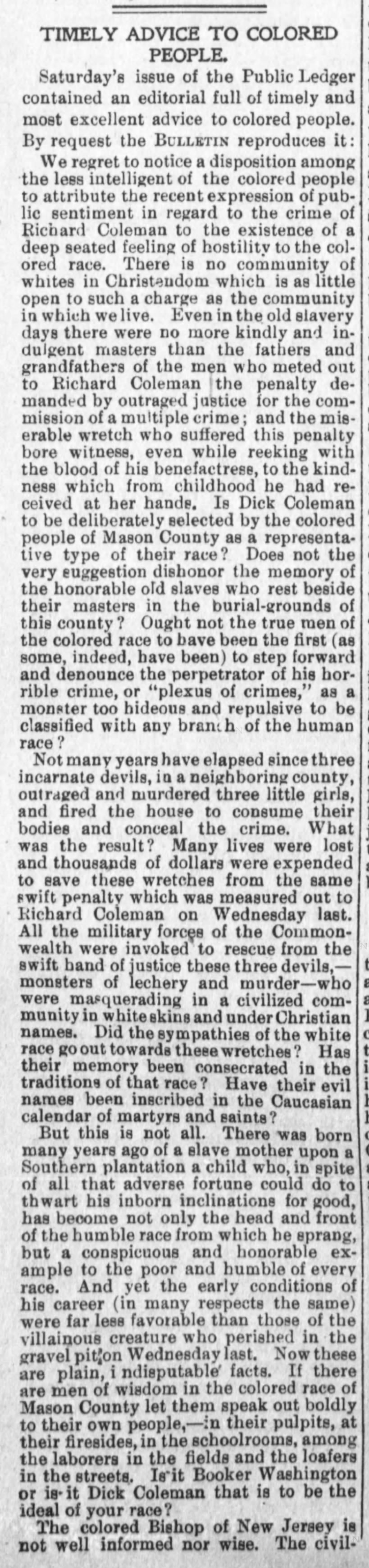
We regret to notice a disposition among the less intelligent of the colored people to attribute the recent expression of public sentiment in regard to the crime of Richard Coleman to the existence of a deep seated feeling of hostility to the colored race. There is no community of whites in Christendom which is as little open to such a charge as the community in which we live. Even in the old slavery days there were no more kindly and indulgent masters than the fathers and grandfathers of the men who meted out to Richard Coleman the penalty demanded by outraged justice for the commission of a multiple crime; and the miserable wretch who suffered this penalty bore witness, even while reeking with the blood of his benefactress, to the kindness which from childhood he had received at her hands. Is Dick Coleman to be deliberately selected by the colored people of Mason County as a representative type of their race? Does not the very suggestion dishonor the memory of the honorable old slaves who rest beside their masters in the burial-grounds of this county? Ought not the true men of the colored race to have been the first (as some, indeed, have been) to step forward and denounce the perpetrator of his horrible crime, or “plexus of crimes,” as a monster too hideous and repulsive to be classified with any branch of the human race?
Not many years have elapsed since three incarnate devils, in a neighboring county, outraged and murdered three little girls, and fired the house to consume their bodies and conceal the crime. What was the result? Many lives were lost and thousands of dollars were expended to save these wretches from the same swift penalty which was measured out to Richard Coleman on Wednesday last. All the military forces of the Commonwealth were invoked to rescue from the swift hand of justice these three devils, monsters of lechery and murder who were masquerading in a civilized community in white skins and under Christian names. Did the sympathies of the white race go out towards these wretches? Has their memory been consecrated in the traditions of that race? Have their evil names been inscribed in the Caucasian calendar of martyrs and saints? But this is not all.
There was born many years ago of a slave mother upon a Southern plantation a child who, in spite of all that adverse fortune could do to thwart his inborn inclinations for good, has become not only the head and front of the humble race from which he sprang, but a conspicuous and honorable example to the poor and humble of every race. And yet the early conditions of his career (in many respects the same) were far less favorable than those of tho villainous creature who perished in tho gravel pit on Wednesday last. Now these are plain, indisputable facts.
If there are men of wisdom in the colored race of Mason County let them speak out boldly to their own people,– in their pulpits, at their firesides, in the schoolrooms, among the laborers in the fields and the loafers in the streets. Is it Booker Washington or is it Dick Coleman that is to be the ideal of your race?
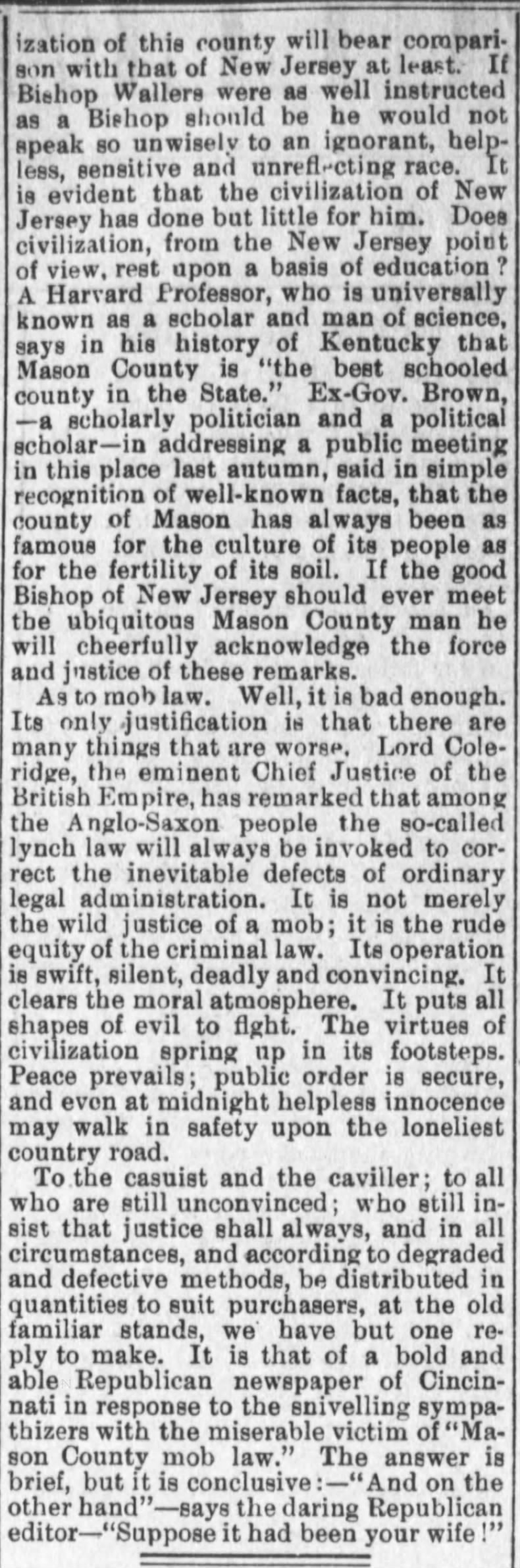
The colored Bishop of New Jersey is not well informed nor wise. The civilization of this county will bear comparison with that of New Jersey at least. If Bishop Wallers were as well instructed as a Bishop should be he would not speak so unwisely to on ignorant, helpless, sensitive and unreflecting race. It is evident that the civilization of New Jersey has done but little for him. Does civilization, from the New Jersey point of view, rest upon a basis of education? A Harvard Professor, who is universally known as a scholar and man of science, says in his history of Kentucky that Mason County is “the best schooled county in the State.” Ex-Gov. Brown, a scholarly politician and a political scholar in addressing a public meeting in this place last autumn, said in simple recognition of well-known facts, that the county of Mason has always been as famous for the culture of its people as for the fertility of its soil. If the good Bishop of New Jersey should ever meet the ubiquitous Mason County man he will cheerfully acknowledge the force and justice of these remarks.
As to mob law. Well, it is bad enough. Its only justification in that there are many things that are worse. Lord Coleridge, the eminent Chief Justice of the British Empire, has remarked that among the Anglo-Saxon people the so-called lynch law will always be invoked to correct the inevitable defects of ordinary legal administration. It is not merely the wild justice of a mob; it is the rude equity of the criminal law. Its operation is swift, silent, deadly and convincing. It clears the moral atmosphere. It puts all shapes of evil to fight. The virtues of civilization spring up in its footsteps. Peace prevails; public order is secure, and even at midnight helpless innocence may walk in safety upon the loneliest country road.
To the casuist and the caviller [sic]; to all who are still unconvinced; who still insist that justice shall always, and in all circumstances, and according to degraded and defective methods, be distributed in quantities to suit purchasers, at the old familiar stands, we have but one reply to make. It is that of a bold and able Republican newspaper of Cincinnati in response to tho snivelling sympathizers with the miserable victim of “Mason County mob law.” The answer is brief, but it is conclusive: “And on the other hand” –says the daring Republican editor– “Suppose it had been your wife!”
Source
Publisher
Date
Contributor
Format
Coverage
Files