
General Workflow
Biographies
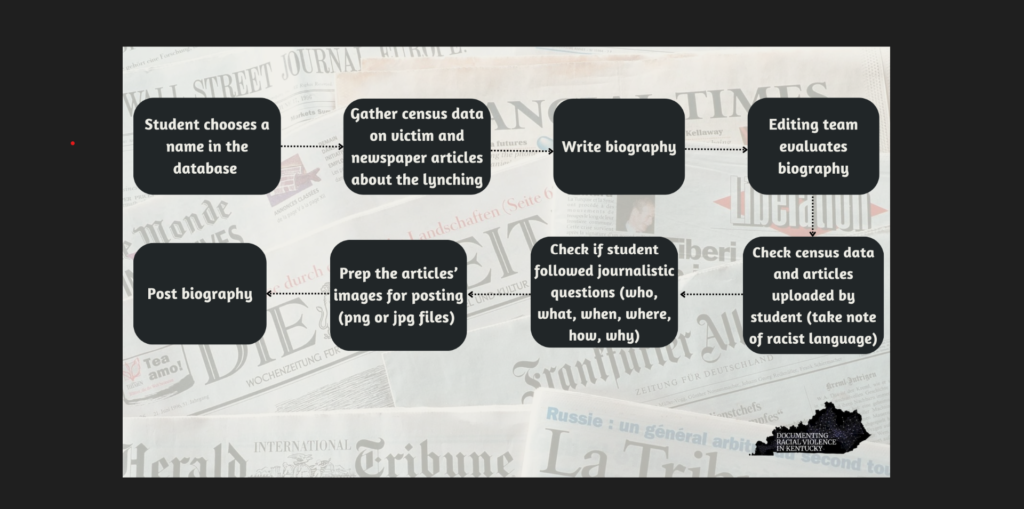
Transcriptions
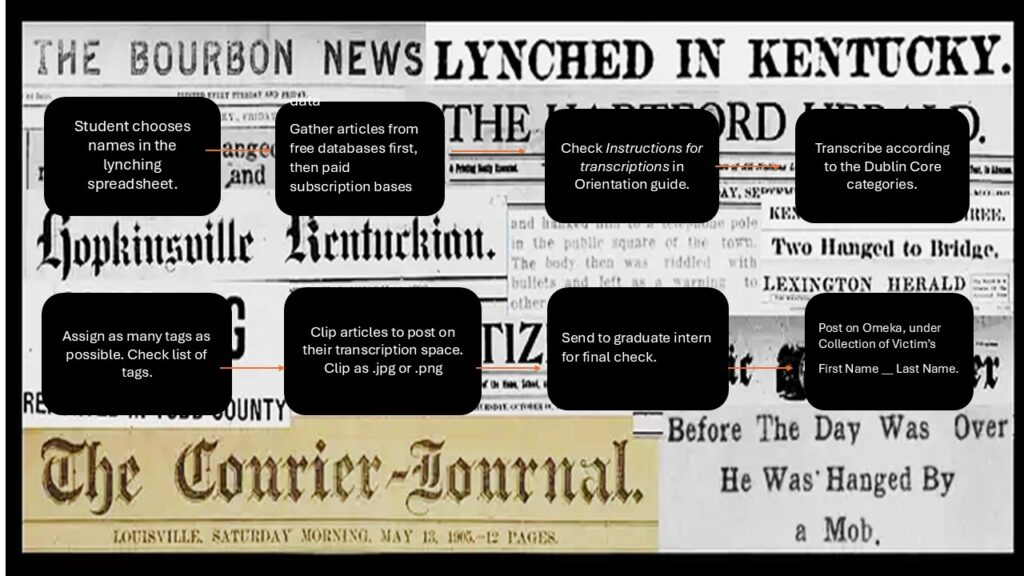
Methodology for Biographies
| Tasks – Biographies and workflow | DRVK editing team: what it looks for |
| Writing biographies | Gathering census data, articles, checking all relevant and available websites for articles providing different types of information |
| Evaluating Biographies | Journalist questions, active vs passive tense, use of racist language, send to Dr. Brown or Dr. Goan for final evaluation |
| Posting Biographies | Prepping the articles images as jpg or png files, etc. |
Methodology for Transcriptions
| Tasks – Transcriptions and workflow | DRVK editing team: what it looks for |
| Gathering articles | Consult lynching databases, search for primary sources, identifying duplicate articles |
| Transcribing articles | Preparing for Omeka; labeling names, dates, and locations; categorizing by using the Dublin Core |
| Posting Transcriptions | Writing out the article as close to word-for-word as possible; assigning appropriate tags; giving to graduate student to proofread; posting on Omeka side |
Summary of Biography Workflow by Task
Spreadsheet of all lynching victims in Kentucky (Source: Racial Violence in Kentucky, Appendix 1)
Brief summary of researching biographies
The editorial team creates a research folder for every undergraduate intern on a Google drive. The student’s folders hold articles, drafts, and template for submission. In the first orientation meeting, Jennifer Hootman creates accounts for students on createuky.net to upload their transcriptions. In the same meeting, the editorial team introduces the students to the databases and the research guide. The research guide is the first link under the Resources page of the DRVK website, under the heading Click here for a research guide that features the NAACP’s Thirty Years of Lynching. We also present and review an updated version of the database, in which all completed biographies are in a color-coded spreadsheet, in which all completed biographies and transcriptions are highlighted in yellow. This prevents duplicate work.
Students identify 5 victims to work on for the rest of the semester. In their research, students review census information for personal information about the victim, including children, work, and literacy. As the students gather articles and begin to draft their biographies, they take note of racially biased language in the articles. The language will be tagged for the Omeka side.
Click here to download a PDF of researching guidelines.
Brief summary of writing biographies
In this task, students have two goals to accomplish – answer the journalist questions and fill in the biography template. The journalist questions help students look for the facts and help them cut through the racially biased language. The first paragraph of the biography always speaks to the personal information of the victim. It focuses on family connections, work, residential location, and amount of education.
In the second paragraph, the student focuses on the lynching incident. Providing as much detail as possible, the student describes what happened to the extent that this is knowable and verifiable. The student also keeps track of the ways the newspaper depicted the victim and the incident. Many newspapers blamed the victim for the lynching and described the lynching as part of the normal judicial process. Prejudicial language is tagged for the transcription side of the archive.
Close scrutiny is paid to the tense the student uses to write the biography. Posted biographies avoid passive language, such as “the victims were lynched” or “the victims was taken from the jail.” Instead, the editorial team corrects biographies so that they say, “a mob gathered in front of the victim’s house” or “ a mob stormed the jail and kidnapped the victim.”
Student draft and revise their biographies until they are satisfied with the final product. Then students submit the draft to me using the biography template. They also submit their information to the mapping intern.
Click here to download a PDF of writing guidelines.
Brief summary of posting biographies
At the biweekly intern meeting, students present work that they have completed. Dr. Brown and Dr. Goan note the completed biographies and then review the submissions. Dr. Brown or Dr. Goan edit the biography for clarity, length, tone, tense, and accuracy. A graduate intern double checks the accessibility of the submissions to make sure the article is readable, accessible for free or behind a paywall, and properly cited by the undergraduate intern. The graduate intern generates a reference list for all the research data.
Dr. Brown creates a secondary folder in OneDrive for each lynching victim and all the supporting articles and census data. From the OneDrive, Dr. Brown verifies the article clippings are saved in JPG or PNG format. All information is loaded to the WordPress side. Dr. Brown creates a post for the biography based on the articles and census data.
A note on article clippings: if the article was published before 1923, it is in the public domain and can be reproduced without copyright infringement. Articles printed after 1923 may or may not be in the public domain, depending on where they are published and if a special technique has been used to clip them from a website like Chronicling America or Newspapers.com. All data on this digital archive is in promotion of educational research. Please make sure to fully cite all articles and data you have found on this website, preferably using the Turabian method (click here to view).
The mapping interns also make a presentation on the development of new maps. Using the research data, the mapping intern creates two maps of the lynching, one with a strong local focus and one showing where the lynching occurred in the general map of Kentucky.
Click here to download a PDF of the posting guidelines.
Summary of Transcription workflow by task
Brief summary of identifying articles
The editorial team creates a research folder for every undergraduate intern on a Google drive. The student’s folders hold articles, drafts, and template for submission. In the first orientation meeting, Jennifer Hootman creates accounts for students on createuky.net to upload their transcriptions. In the same meeting, the editorial team introduces the students to the databases and the research guide. The research guide is the first link under the Resources page of the DRVK website, under the heading Click here for a research guide that features the NAACP’s Thirty Years of Lynching. We also present and review an updated version of the database, in which all completed biographies are in a color-coded spreadsheet, in which all completed biographies and transcriptions are highlighted in yellow. This prevents duplicate work.
Students identify 3 to 5 victims to work on for the rest of the semester. Using the links provided on the research
Transcription workflow
- Read full primary source.
- Title– for lynching cases, use the following format:
- Last name of victim, Newspaper, Full date. Eg. James, Woodford Sun, March 17, 1921.
- Title for other incidents–
- Subject– for lynching cases, fill in the following:
- Last name, first name of victim(s) [May, Richard]
- Charge against lynched person [Charge, rape]
- Method of killing [Mob, hanging]
- Number of people reported in mob (if applicable) [Mob, 200 members]
- Mob masked or unmasked? (if information available) [Mob, masked]
- Editorials should be marked under subject line “Editorial.”
- Description– Put your article transcription here.
- Source– Place/platform primary source was found on; eg. Chronicling America, Newspapers.com, or Papers of the NAACP. Link to the source if it is open access.
- Publisher– Newspaper or direct source of primary source. Eg. Lexington Herald-Leader.
- Date– Date primary source published, in following format YYYY–MM-DD.
- Format– Format of attached file eg. Image, JPG (or PNG).
- Coverage– Location of incident. Ideally one town and county (Versailles, Woodford County). Where multiple towns mentioned, use semi-colons (Versailles; Midway, Woodford County).
- Relation: Check the HTML box to include a link back to the victim’s biography page. Use this format: Documenting Racial Violence in Kentucky, Clifford, William
- Files– Attach file of primary source.
- Collection– Add to collection of county incident occurred in. If multiple areas, I have been sorting by county in which death occurred.
- Tags– Decade and year of incident (eg. 1927 + 1920-1930), along with last name of victim, and towns involved in incident (as well as county where death occurred). Editorials should be marked thusly. Finally add your full name.