
James, Woodford Sun, March 17, 1921
Dublin Core
Title
Subject
Description
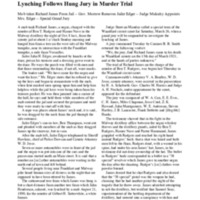
Lynching Follows Hung Jury in Murder Trial
Mob takes Richard James From Jail — Gov. Morrow Removes Jailer Edger — Judge Mulcahy Appoints
Mrs. Edger — Special Grand Jury
A mob took Richard James, a negro, charged with the
murder of Ben T. Rodgers and Homer Nave in the
Midway distillery the night of Oct. 8 last., from the
county jail at about 1 o’clock Sunday morning and
hanged him from a tree on the west side of the Midway
turnpike, near its intersection with the Frankfort
turnpike, a mile from Versailles.
Jailer John H. Edger, awakened by knocks at the
door, put on his trousers and a dressing gown went to
the door. He ways the porch was filled with men and
that those surrounding the door, if not all, wore masks.
The leader said: “We have come for the negro and
want the keys.” Mr. Edger states that he refused to give
up the keys and began to remonstrate with the mob,
when four masked men sprang upon him and help him
helpless while the jail keys were being taken from his
trousers pocket. He was then jammed into a corner of
the hall, he says and held there while members of the
mob entered the jail and secured the prisoner and until
they were ready to start off with him.
A rope was places about James’ neck and, it is said,
he was dragged by the neck from the jail through the
side entrance.
Jailer Edger’s son-in-law, Ben Thompson, went out
and pleaded with members of the mob as they dragged
James up the stairway, but in vain.
After the mob left, Jailer Edger telephoned to Sheriff
Hawkins, chief of Police Dawson and County Attorney
W. D. Jesse.
Seven or more automobiles were in front of the jail
and the negro was put into one of the cars and the
procession started north on Main street. It is said that a
number on [sic] other automobiles were waiting in the
north end of town and fell behind.
Several people living near Frankfort and Midway
pike heard human cries of distress in the night that are
supposed to have been uttered by James.
The cottonwood tree from which James was hung is
but a short distance from another tree from which John
Henderson, colored, was lynched by a mob August 21,
1890, for the murder of Gilbert H. Satterwhite, a white
farmer.
James’ body was cut down at about 4 a.m. and was
taken to a colored undertaking establishment. It was
buried at Midway on Monday.
Judge Stout on Monday called a special term of the
Woodford circuit court for Saturday, March 26, when a
grand jury will be empaneled to investigate the
lynching of James.
A jury summoned Tuesday by Coroner B. B. Smith
returned the following verdict:
“We, the jury, find Richard James came to his death
in Woodford county on the 13th day of March 1921,
and at the hands of parties unknown.”
The trial of Richard James on the charge of the
murder of Ben T. Rodgers, was begun last Thursday in
the Woodford circuit court.
Commonwealth’s Attorney V. A. Bradley, W. D.
Jesse, county attorney, were assisted in the prosecution
by H. A. Schoberth. Gov. Charles M. Harriss and Judge
A. H. Nuckols, under appointment by the court,
appeared for the defendant.
The jury was composed of W. A. Cox, E. E. Eves,
C. H. Jones, Miles Chapman, Jesse Curd, Z. K.
Howard, John Montgomery, W. E. Anderson, Steven
Hartley, J. B. Lancaster, Frank Sublette and [illegible]
Hanks.
The testimony showed that in the fight in the
Midway distillery office between the negro whiskey
thieves and the distillery guards, aided by Ben T.
Rodgers, Homer Nave and Porter Hammond, James
grappled with Rodgers and reached his right hand
around Rodgers’ back: that a shot was heard and both
men fell to the floor, Rodgers dead, with a wound in his
spine, had under his arm James’ hat. James, in his
testimony did not deny ownership of the hat. The bullet
in Rodgers’ body corresponded to a bullet in a “38
special” revolver which James gave to another negro
the day after the shooting. Rodger’s [sic] clothes were
powder burned.
James denied that he shot Rodgers and also denied
that the “38 special” pistol was the weapon he had,
claiming that he had another pistol the night of the
tragedy that he threw away. James admitted attempting
to rob the distillery, but testified that Samuel Seay,
superintendent of the bottling department of the
distillery, had entered into a conspiracy with him and
other negroes by which the negroes were to steal
whiskey from he distillery warehouse and dispose of it,
dividing the proceeds “50-50” with Seay.
Seay took the stand and emphatically denied this. He
admitted when questioned that there were at the present
time charges against him in Federal Court in
connection with alleged whiskey thefts at the distillery.
The case was argued by Commonwealth’s Attorney
Bradley and H. A. Schoberth for the Commonwealth
and by Judge A. H. Nuckols and Gov. Charles M.
Harris for the defense. It was given to the jury at 5
o’clock Friday afternoon.
Eleven of the jury voted for the death sentence, but
the twelfth man, W. E. Anderson, held out for life
imprisonment and was immovable. He said the Bible
was against taking any man’s life and he had
misunderstood the questions asked him when he
qualified for jury service. After the jury had been out
for 24 hours it was discharged at 5:10 Saturday
afternoon.
Large crowds attended the trial and there was much
feeling over the mistrial. The feeling was believed to
have been allayed, however, when Judge Stout issued
an order for a special term of court March 28 to re-try
the case.
After the jury was dismissed, Gov. Harriss and
Judge Nuckols, who had defended James under
appointment by the court, asked to be released from
further connection with the case and Judge Stout
granted their request.
Judge Stout’s Comment
Paris, Ky., March 14 — “So long as the better class of
citizens in any community shirks jury duty and the
courts are then compelled to take on persons unfit for
jury service, just as long will the mob spirit
occasionally rear its head,” said Circuit Judge Robert L.
Stout here this morning in delivering his charge to the
grand jury of the March term of Bourbon circuit court.
“It is the duty of every good citizen to give up his
time to the service of his State. If a criminal feels he
has been given a fair trial, he is satisfied more or less,
no matter what the verdict may have been. So long as
the citizens believe that both the State and the defense
has had a square deal, there will be no trouble. But if
the juries are made up in part of persons upfit [sic] to
serve then occasionally the mob spirit will arise.
“This was demonstrated at Versailles Sunday when
a mob took the negro Richard James, from the
Woodford county jail and executed him. but for the
presence in the case of one unfit juror this unfortunate
incident count not have happened.”
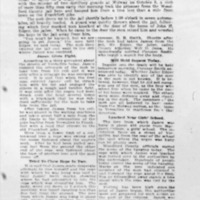
Second article under front page headline:
Gov. E. P. Morrow, acting under the new law which
provides for the removal from office of a peace officer
who permits a prisoner to be taken from his custody by
a mob, issued a proclamation Monday removing John.
H. Edger from the office of county jailer.
Mr. Edger will file a petition for reinstatement, as
the law gives him the right to do. The law provides that
after hearing the evidence “if the Governor be of the
opinion that the officer had done all in his power to
protect the life and person of such prisoner, and that the
officer had not neglected to perform his legal duty, then
the Governor shall order the immediate reinstatement
of such removed officer.”
Gov. Morrow also offered a reward of $500 for the
arrest and conviction of any member of the mob and
addressed letters to County Judge E. Mulcahy and
County Attorney W. D. Jesse requesting them to make
a searching investigation of the mob and if possible to
ascertain the names of the members. The response of
these officers to the Governor was that a special term of
circuit court had been called for this purpose and that
the grand jury then empaneled [sic] would have an
authority not conceded to a court of inquiry.
Judge Mulcahy on Monday appointed Mrs. John H.
Edger as county jailer to fill the vacancy caused by the
removal of her husband. Mrs. Edger too the oath of
office and executed bond in the penal sum of $5,000,
with W. H. Edwards, Jr., surety.
Mrs. Edger, as far as we know, is the first woman to
hold the office of jailer in Kentucky. In the event Gov.
Morrow should fail to reinstate Mr. Edger, she will
hold office for the remainder of the term, or until Jan 1,
1922.
Mr. Edger and his attorney, Field McLeod, went to
Frankfort yesterday and requested of Gov. Morrow a
hearing of Mr. Edger’s claims for reinstatement as
jailer. The Governor set the hearing for next
Wednesday, March 23.
Source
Publisher
Date
Contributor
Format
Coverage
Files